Intermediary Data Services: The Higher Education Access Tracker (HEAT)
This section is included in the guidance because HEAT1 is one of the largest higher education data-tracking services in England. TASO acknowledges that HEAT is not an administrative database, rather, it is a centralised tracking service that negotiates access to the majority of variables covered in this administrative guidance resource. HEAT works with external administrative bodies to obtain linked administrative data on behalf of its members and disseminates this back to them for evaluation purposes.
HEAT is a non-profit membership organisation made up of HEPs and other partners working together to evaluate equality of opportunity activity. It tracks both pre and post entry activity, enabling members to follow students longitudinally across time and across multiple educational datasets. Through this centralised tracking, HEAT members can access a wide range of long-term outcomes relevant to equality of opportunity work, including GCSE and A-level attainment, and progression, access and success in HE and beyond.
HEAT negotiates access to administrative data such as the NPD and HESA records and returns aggregated linked outcomes to members, along with dashboards to support analysis. This allows members to evaluate the impact of their interventions using robust methods without each institution needing to negotiate data access independently.
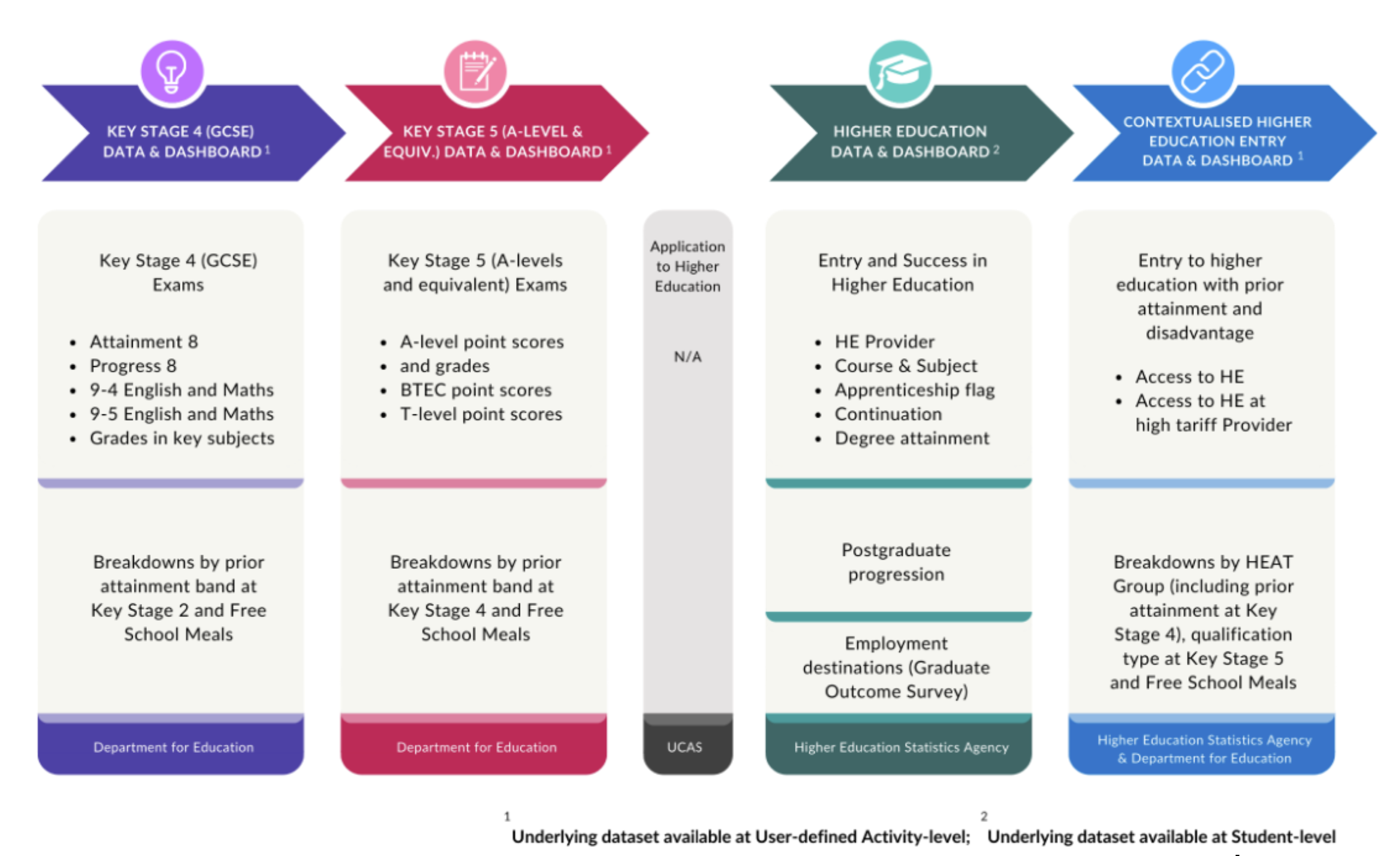
As the majority of outcomes covered in this resource are available through the HEAT Service (Figure 2), it is strongly recommended that HEPs consult HEAT before undertaking their own data linking with administrative bodies. HEAT can advise whether the research questions can be addressed using its existing outcome datasets, reducing duplication of effort and minimising burden on external data providers.
In addition to sourcing administrative data for its members, HEAT accepts research applications from external researchers who wish to analyse aggregate HEAT data on outreach activity delivered by member organisations. Applicants do not need to belong to a HEAT member institution. External researchers interested in understanding more about the application process and the specifics of the available data are advised to contact HEAT directly.
References
Footnotes
In the HE sector, there are two national tracking services – the Higher Education Access Tracker (HEAT) and AimHigher West Midlands. A third tracking service - the East Midlands Widening Participation Research and Evaluation Partnership (EMWPREP) - closed in summer 2025. This document focuses on HEAT because it has the broadest coverage and is subscribed to by the majority of English higher education providers.↩︎